
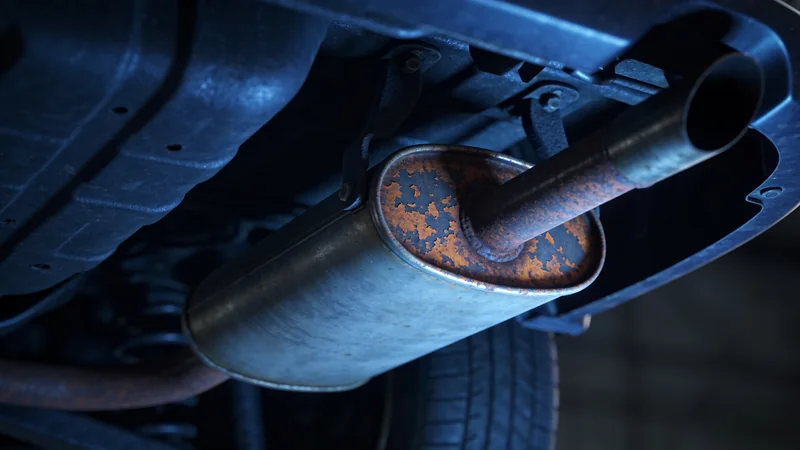
Illustration: a rusted exhaust pipe and muffler under a car
MUFFLER & EXHAUST · SAUGUS, MA
Car suddenly louder, rattling underneath or smelling of fumes? V-Tech Auto Services does muffler repair in Saugus, MA, and our team shows you what's rusted, loose or leaking before anything is repaired or replaced.
Open Monday–Friday, 8:00 AM–5:00 PM · Closed weekends
 Our shop in SaugusReal photos, further down
Your exhaust system carries hot gases from the engine to the back of the car, cleans them along the way and quiets them down. When part of it fails, you usually hear it, smell it or see it:
Fumes inside the car? Windows down, then call us.
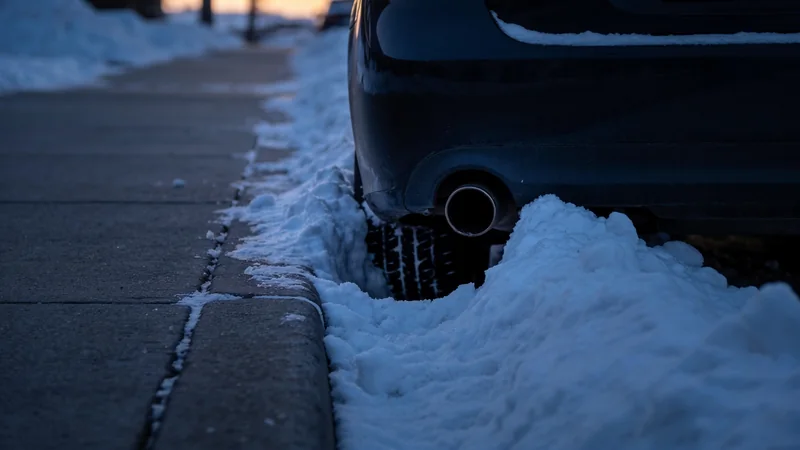
Illustration: a tailpipe just above a snowbank at the curb
Most exhaust problems are about noise. One is about safety. Exhaust contains carbon monoxide, a gas you can't see or smell. If you can smell exhaust inside the car, fumes are getting in, and carbon monoxide can be getting in with them.
If that happens:
Two winter habits worth keeping: never warm up the car in a closed garage, and after a snowstorm, clear the snow away from the tailpipe before you start the engine. A blocked tailpipe can push exhaust into the car.
V-Tech Auto Services repairs and replaces muffler and exhaust components on foreign and domestic cars. Here's what's under there, front to back:
When the trouble is a sensor or the catalytic converter, we tell you plainly what it needs.
On the North Shore, road salt is the exhaust system's worst enemy. Salt speeds up rust, and exhaust pipes also collect moisture from the inside, especially on short trips, so mufflers and pipes often rust from the inside out as well as from the outside in.
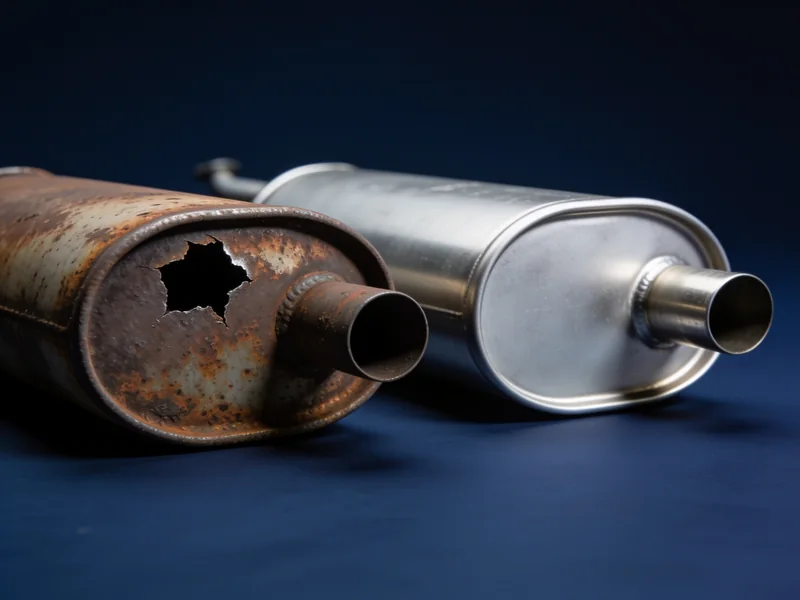
Exhaust parts don't always need replacing. A rattle from a loose heat shield or a broken hanger can be a small fix. A muffler rusted through, or a pipe that's thin and flaking, usually means replacing that section, because a patch on rust-thin metal rarely lasts.
With the car up on the lift, we can show you exactly where it's rusted, loose or leaking and explain which fix makes sense and why. A noise that's annoying but not dangerous is "can wait", and we'll say so, so you decide when to fix it. A fume smell inside the car is "fix now".
We don't post exhaust prices, because two cars making the same noise can need very different work. What moves it:
… He showed me all the work he was going to complete and everything after he completed it. …
A sudden roar or rumble usually means the exhaust has a new opening: a muffler that rusted through, a cracked pipe, or a joint or gasket that let go. It's often worse when you accelerate or first start the car. Loud on its own is a comfort problem; loud plus a fume smell inside the car is a safety problem. Either way, have it looked at before a small leak becomes a broken pipe.
It depends on where the leak is and whether fumes reach the cabin. A small leak near the back of the car is mostly noise, but a leak under the seats or near the engine can let exhaust in. If you smell exhaust inside, keep the windows open, keep the trip short and get it checked right away. Don't let a leak ride through the winter, when the windows stay closed.
Yes, it can. The engine's computer uses oxygen sensors in the exhaust to adjust the fuel mixture, and a leak ahead of a sensor can pull in outside air and throw off its reading. That can turn on the light and change how the engine runs. The light can mean many other things too, so the code needs a proper look; see check engine light diagnostics.
Both, depending on what we find. A loose hanger or heat shield can often be refastened or fixed, while a muffler or pipe that's rusted through usually needs that section replaced. We show you the problem when we can, and you hear why one makes more sense than the other before any work starts.
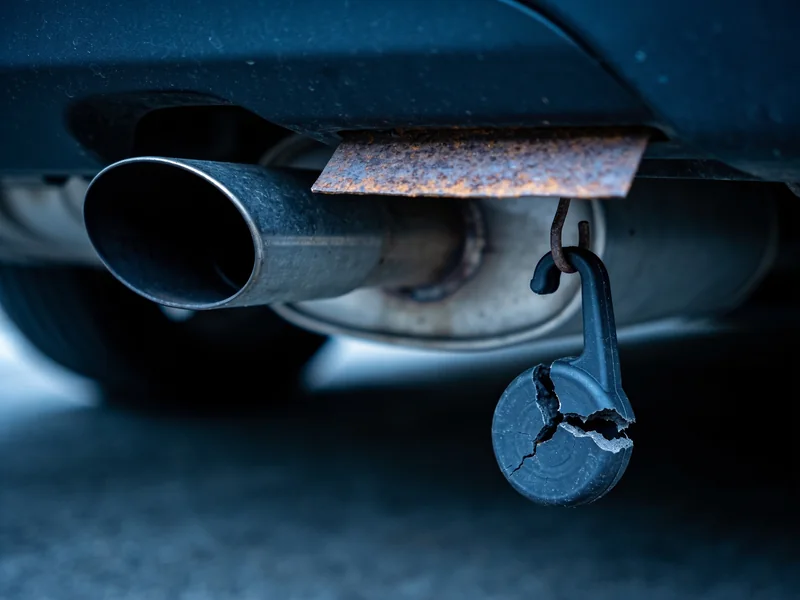
The usual suspects are a loose or rusted heat shield, a broken hanger or clamp, or a loose piece inside the muffler itself. A tinny rattle at idle or over bumps is often a heat shield. Most rattles aren't urgent, but a hanger that breaks can let a pipe drop and drag, so don't ignore one for months.
Yes. Salt and slush speed up rust on everything under the car, and the exhaust is often the first part to show it. Rinsing the underside of the car during the winter helps slow it down. If you hear a new noise in the spring after a salty winter, get it checked before a small hole grows.
The shop is at 24 Winter St in Saugus. Our service area is Saugus and the nearby North Shore towns below.



Real photos of our shop in Saugus, taken by drone.
Tell us what you're hearing or smelling, and we'll tell you how soon it needs a look.
Closed right now? Send us a message, and call us Monday–Friday, 8 AM–5 PM.